Robots and automation in cleaning: gadget or revolution?
Can an autonomous floor scrubber replace a cleaner? The National Occupational Classification lists 13 main duties for this trade. A floor robot only touches part of three, and only at floor level. That simple count does not tell the whole story, but it sets the right frame: here is what robots really do in stores and homes, what they leave to people, what the job data show and which skills are gaining value.
What cleaning robots really do
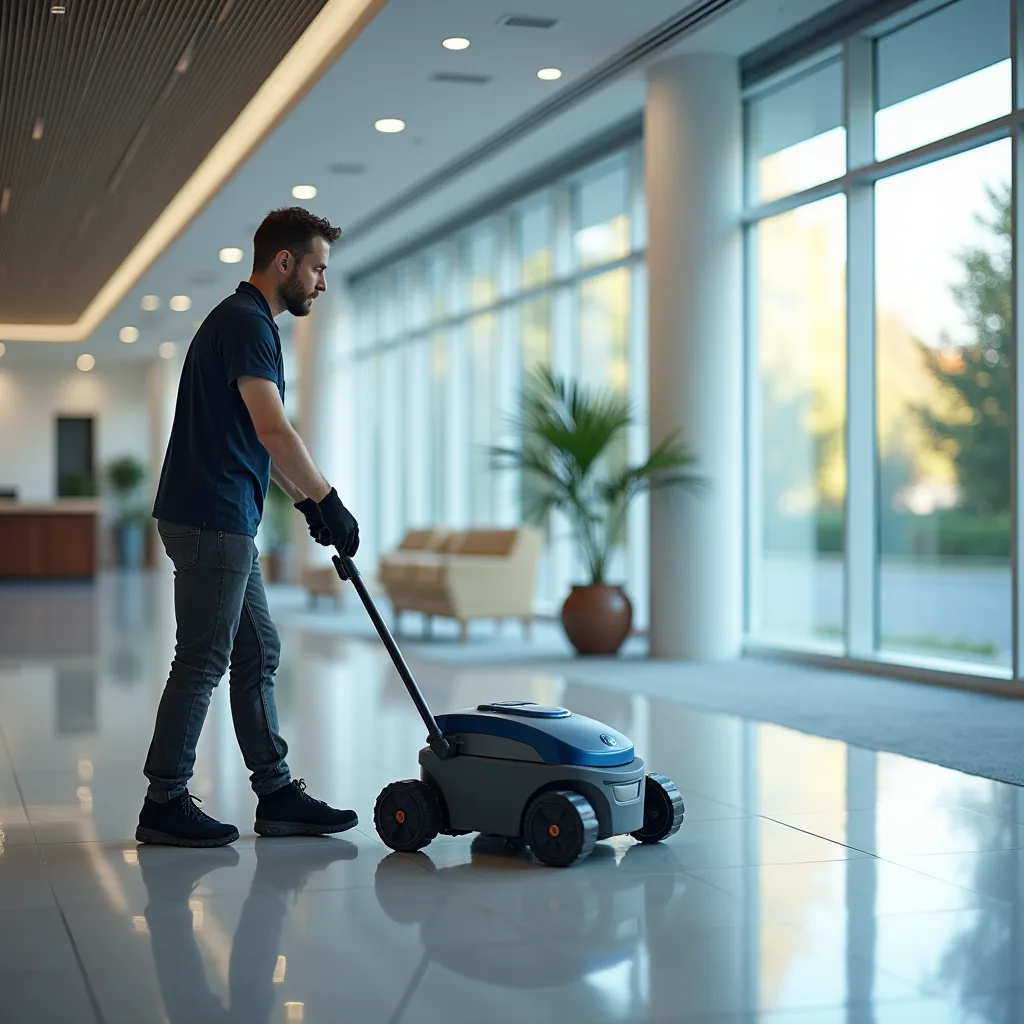
There are two families of devices. In stores and large buildings, autonomous floor scrubbers and vacuums are appearing: you show them a route or let them map the space, then they wash or vacuum large areas along that path, going around obstacles. In homes, they are mostly robot vacuums, sometimes with mopping, that go from room to room and return to their charging base on their own.
Both share the same strength: clear, repetitive floor space. A school corridor, a store floor or a lobby lend themselves to automation, because the surface is large, flat and nearly identical from one day to the next. Their weakness is everything else: stairs, corners, under cluttered furniture, thick rugs, cords on the floor, and anything above floor level.
A robot does not maintain itself either. Someone has to empty the bin, clean the brushes and filters, fill or drain the water tanks, free the device when it gets stuck and check that it actually did the job. In other words, it shifts part of the task; it does not make it disappear.
The tasks they leave to people
To measure the real effect, start with the official list of duties. The National Occupational Classification (NOC 2021) describes 13 main duties for light duty cleaners. Here is what a floor robot can do with them:
| Duty described in the NOC | Can a floor robot do it? |
|---|---|
| Sweep, mop, wash, wax and polish floors | Partly: sweeping and washing large clear areas |
| Dust furniture and vacuum carpeting, area rugs, draperies and upholstered furniture | Carpeting only; the rest is out of reach |
| Make beds, change sheets, distribute towels and toiletries | No |
| Clean, disinfect and polish kitchen and bathroom fixtures and appliances | No |
| Clean and disinfect public areas (showers, changing rooms, elevators) | Floors only |
| Disinfect operating rooms and other hospital areas | No |
| Pick up debris and empty trash containers | No |
| Wash windows, walls and ceilings | No |
| Stock supplies, store lost and found items, provide information, handle complaints | No |
The finding is clear: out of 13 duties, a floor robot only touches part of three, and only at floor level. For janitors, caretakers and heavy-duty cleaners, the NOC adds even more varied tasks, such as moving heavy furniture, clearing snow from sidewalks or maintaining grounds. What stays with people is the detail work, disinfection, judgment ("that stain needs a different product") and the relationship with the client.
Gadget or revolution? What the job data show
If robots were replacing cleaning staff on a large scale, you would expect job openings to shrink. In Quebec, the opposite is happening. According to Statistics Canada, job vacancies for light duty cleaners went from 1,320 in the second quarter of 2025 to 2,205 in the second quarter of 2026. For janitors, caretakers and heavy-duty cleaners, they went from 420 to 560, an estimate of acceptable quality.
| Occupation (Quebec) | Vacancies Q2 2025 | Vacancies Q2 2026 | Average offered wage Q2 2026 |
|---|---|---|---|
| Light duty cleaners | 1,320 | 2,205 | $21.00 |
| Janitors, caretakers and heavy-duty cleaners | 420 | 560 | $22.85 |
The Quebec government's profile for unit group 65310 completes the picture. It counts 69,000 people employed in 2024 across Quebec, with hourly wages ranging from $16.60 to $25.00 and a median of $21.00 (average for 2023 to 2025). Above all, it shows where these people work: 38% in administrative and support services (the cleaning companies that serve buildings and stores), 26% in health care, 7% in accommodation and food services and 7% in other services.
That breakdown sheds light on the robot question. Large buildings and stores, where an autonomous floor scrubber belongs, are only part of the picture. In health care, more than a quarter of the jobs, the heart of the work is disinfecting rooms, bathrooms and high-touch surfaces, a task no floor robot does.
These figures do not measure the effect of robots, and a one-year increase is not a trend. But nothing in the public data shows demand for these trades falling. The fairest answer to the question in the title is therefore: neither gadget nor revolution. The robot is one more tool, useful on large surfaces, that changes the workday without replacing the trade.
The new skills employers are looking for
Where a robot arrives, the job changes. The person who used to do floors by hand becomes the one who plans, launches and monitors the robot while handling the bathrooms. The skills gaining value:
- programming zones and cleaning schedules, often from an app or a touchscreen;
- doing basic maintenance: bins, brushes, filters, tanks, charging;
- reading the device's alerts and reports, then going back over what it missed;
- preparing the space: clearing the floor, tidying cords, flagging obstacles;
- recognizing a breakdown and reporting it to the right place.
For employers, these new devices come with obligations. Quebec's Act respecting occupational health and safety requires employers to provide safe equipment and keep it in good condition, to properly inform workers of the risks of their work, and to provide appropriate training, coaching and supervision. And training required by the employer is paid working time, as explained in Minimum wage in Quebec: what it covers and what it does not.
Privacy: a robot that maps the premises
To find their way, many robots use sensors, and some use cameras. They create a map of the premises and sometimes images. In a home or an office, that is not trivial: the map shows where people live and work.
Quebec's Act respecting the protection of personal information in the private sector covers some of these situations. When a business collects personal information from a person using technology that can identify, locate or profile them, it must inform them beforehand, and tell them how to activate those functions. Profiling includes assessing work performance: a device used to measure a person's work falls into that logic.
In practice: if your employer installs a device that collects data about you, you have the right to be informed. If you clean clients' homes, never take photos of the premises without permission, even to "show the work done". For a specific case, the Commission d'accès à l'information is the body to consult. Other technology issues in the service trades are covered in Will AI replace the service trades? What is really changing.
Three settings, three realities: practical cases
The same question, "is a robot worth it here?", does not get the same answer everywhere. Three typical situations in Quebec show why.
A big-box store or a warehouse, overnight
This is the ideal setting: long clear aisles, the same route every night and a night crew already in place. The autonomous floor scrubber does the main aisles while the cleaner handles the washrooms, staff rooms, refrigerated displays and spot spills. The work does not disappear: it shifts toward the tasks the NOC describes as cleaning and disinfecting public areas and bathrooms.
A seniors' residence or a health care facility
The hallway suits a robot, but it runs while residents are moving around with walkers or wheelchairs. The cleaner therefore has to choose when it runs and mark off wet areas. Above all, disinfecting rooms, handrails and high-touch surfaces remains entirely manual. In this setting, the robot at best frees up floor time for disinfection; it does not reduce the need for attentive staff.
A private home, with a residential cleaning business
The robot vacuum usually belongs to the client, not the business. It keeps the floor up between visits, which changes the nature of the visit: less everyday vacuuming, more bathrooms, kitchen, high dusting and deep cleaning. For a self-employed cleaner, it is a chance to review the task list and the price with the client rather than billing for time that no longer matches anything.
For a business that is on the fence, the method is simple: time how long is really spent on the clear floors of one contract for two weeks, then compare it with the device's monthly cost, its maintenance, the time spent preparing the premises and training. Sample calculation, to adapt: if the robot frees up 1.5 hours of floor washing per night, five nights a week, at the $21.00 median wage reported by Québec.ca, that is $157.50 of time per week to redeploy to other tasks. If the contract has no other tasks to give that freed-up time, the device earns nothing.
What this means for you
If you work in cleaning, a robot arriving on a commercial contract is not a threat to your job but a change in tasks. Highlight what it does not do: disinfection, attention to detail, reliability and your ease with equipment. In the introduction of your GPP Emploi profile, mention it if you have already used a floor scrubber or a programmable device. For pay and getting started in the trade, read Residential and commercial cleaning: pay, clients and how to start.
If you run a cleaning business, a robot can make sense on large recurring surfaces, rarely in a cluttered house. Run the numbers on a real contract before buying, and plan for training time. Current listings are on the residential cleaning and commercial cleaning and janitorial pages. Three mistakes come up often: buying the device before measuring the real floor time, forgetting to train the crew and explain what data the robot collects, and promising the client a lower price before seeing the robot work for a month. To get invitations from employers, create your free profile in about 3 minutes.
In short
- Cleaning robots are effective on clear, repetitive floors, especially in large commercial buildings.
- Out of the trade's 13 official duties, a floor robot only touches part of three, and only at floor level: detail work, disinfection and service remain human.
- In Quebec, cleaning job vacancies rose between 2025 and 2026: nothing points to falling demand.
- Skills gaining value: programming, maintaining and monitoring the device; employers must train workers and provide safe equipment.
- A device that collects personal information must be disclosed to the people concerned.
Frequently asked questions
Will robots replace cleaners?
Nothing points that way for now. Robots mostly handle clear floors, a small part of the trade's duties. In Quebec, cleaning job vacancies even rose between the second quarter of 2025 and that of 2026.
What does a cleaning robot do in a store?
It washes or vacuums large areas along a learned or mapped route, going around obstacles. Someone still has to prepare the space, empty it, maintain it and check its work.
What skills do you need to work with cleaning robots?
Knowing how to program zones and schedules, do basic maintenance on the device, read its alerts and prepare the space. These skills add to the trade; they do not replace attention to detail and disinfection.
Does my employer have to train me to use a cleaning robot?
Yes. Quebec's Act respecting occupational health and safety requires employers to inform workers of the risks and provide appropriate training, coaching and supervision. Training required by the employer is also paid working time.
Can a cleaning robot collect information about me?
Some devices use cameras or sensors. If a business collects personal information using technology that can identify you, locate you or assess your work, it must inform you beforehand. The Commission d'accès à l'information can answer specific questions.
Sources
- Explore unit group – NOC 2021 65310 Light duty cleaners - Canada.ca
- Explore unit group – NOC 2021 65312 Janitors, caretakers and heavy-duty cleaners - Canada.ca
- Postes vacants et moyenne du salaire horaire offert selon la profession (groupe de base), données trimestrielles non désaisonnalisées (tableau 14-10-0444-01)
- S-2.1 - Loi sur la santé et la sécurité du travail, article 51
- P-39.1 - Loi sur la protection des renseignements personnels dans le secteur privé, article 8.1
- Préposés / préposées à l'entretien ménager et au nettoyage | Gouvernement du Québec