Roofer: working at heights, licences and pay
A journeyperson roofer earns up to $51.74 an hour on a commercial site. On the roof of a bungalow, the same person may be paid under a completely different rule. The difference comes down to one question: is the site covered by Quebec's Act R-20? Here is what that changes for pay, cards and licences, what the Safety Code requires at heights since 2025, and what the trade's prospects look like.
One trade, two worlds: regulated sites or home renovation
Before talking about pay, you need to know what kind of site you are working on, because the rules change completely. Quebec's Act R-20 governs the construction industry: collective agreements, competency certificates from the Commission de la construction du Québec (CCQ) and wage rates set by sector. It covers, among other things, new construction, rental buildings and commercial, institutional and industrial buildings.
But it includes exclusions. The most important one for a roofer: maintenance, repair, renovation and alteration work done for an individual, for personal and non-profit purposes, on the dwelling they live in. Re-shingling an owner-occupied bungalow is therefore not covered by Act R-20. The same job on a rental six-plex is.
| Type of job | Act R-20 (CCQ) | Contractor's RBQ licence |
|---|---|---|
| Shingles on a house lived in by its owner | Not covered: no CCQ card required | Required |
| Roof of a rental building or a store | Covered: competency certificate and collective agreement | Required |
| Membrane on a school or warehouse | Covered (institutional, commercial or industrial sector) | Required |
In every case, it is the contractor who must hold a licence from the Régie du bâtiment du Québec (RBQ); the subcategory that covers roofing is 7.0, insulation, waterproofing, roofing and exterior cladding contractor. An employed roofer does not need a licence.
Working at heights: the rules that apply on every roof
Here, there is no difference between residential and commercial. Quebec's Act respecting occupational health and safety defines a construction site as any place where foundation, erection, maintenance, renovation, repair, alteration or demolition work is done on a building. The Safety Code for the construction industry applies there, and its fall protection rules were revised in February 2025.
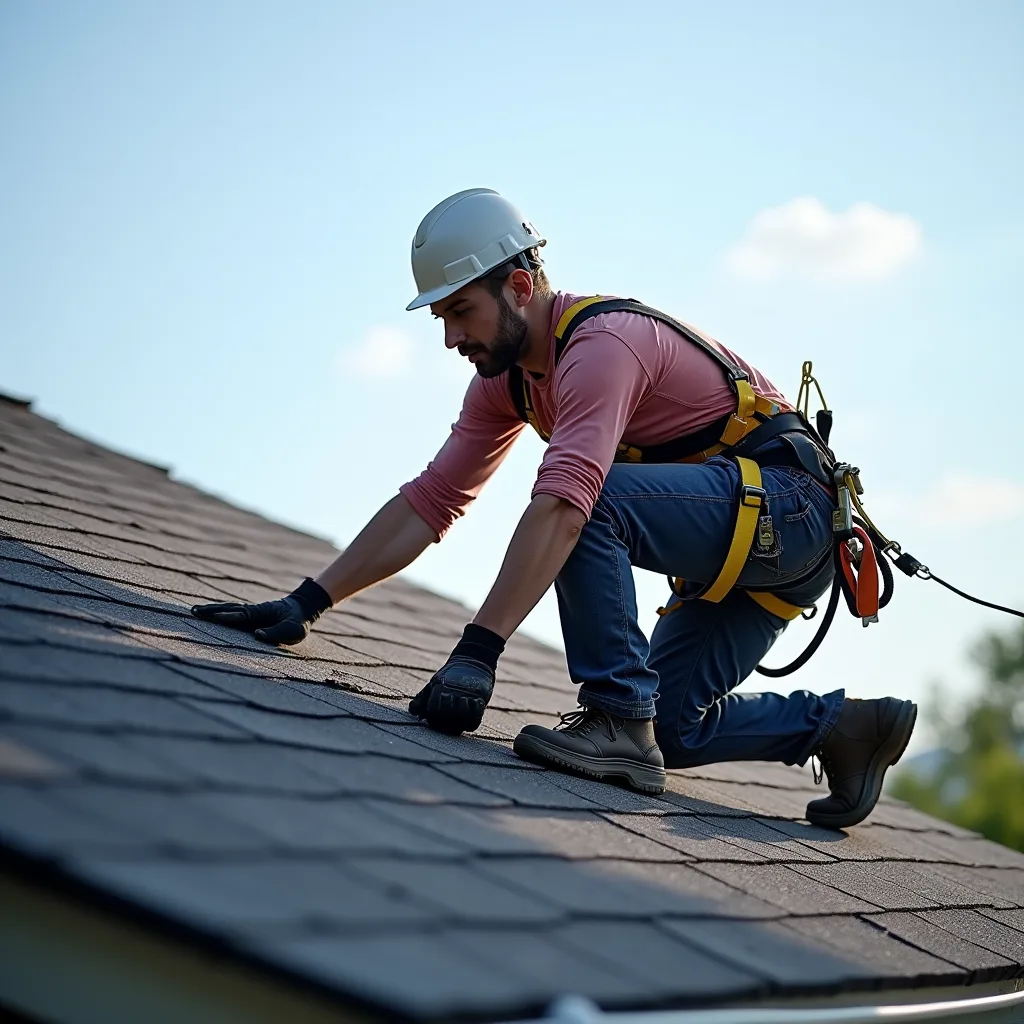
The basic principle: a guardrail must be installed no more than 300 mm from the edge, including the sides of a roof, when a worker could fall more than 3 m (1.2 m when using a vehicle, 1.5 m when handling a load). On a slope steeper than 19° (4/12), a guardrail is not allowed as a means of protection. When a guardrail is impossible or prohibited, the Code sets an order of priority:
- change the work method or position to eliminate the fall risk;
- use a travel restraint system, prohibited on slopes steeper than 15° (3/12);
- install a safety net;
- wear a harness connected to an anchorage system by a fall arrest connecting means.
Two 2025 rules directly affect roofers. A worker suspended in a harness must be released within 15 minutes, which means planning a rescue procedure, training the crew and running drills. And since August 10, 2026, the fall arrest connecting means must be cut-resistant when it may touch a sharp or abrasive edge, such as the edge of a metal roof. For a specific case, the CNESST is the body to consult.
How much a roofer earns
On regulated sites, pay is not negotiated job by job: it is set by collective agreements, according to the sector and your status. Here are the hourly rates published by the CCQ, in effect in August 2026.
| Status | Civil engineering and roadwork | Industrial, institutional and commercial | Light residential |
|---|---|---|---|
| Apprentice, 1st period | $36.22 | $35.84 | $33.50 |
| Apprentice, 2nd period | $43.98 | $43.52 | $40.68 |
| Journeyperson | $51.74 | $51.20 | $47.85 |
The hourly rate does not tell the whole story, because the trade is seasonal and hours vary. The CCQ also publishes average annual earnings for 2025, including premiums, overtime and holiday pay: $21,175 for an apprentice who worked at least one hour, $53,922 for a journeyperson who worked at least one hour, and $71,429 for a journeyperson with at least 500 hours, which was the case for 72% of them. These figures exclude earnings from work not covered by Act R-20.
In residential renovation not covered by the Act, these rates do not apply: pay is whatever you agree on with the employer, at least $16.60 an hour, with overtime at time and a half beyond 40 hours. Always compare an offer on the real hourly rate and on the number of weeks of work it promises.
Training, competency card and access to sites
The main route is the vocational diploma (DEP) Pose de revêtements de toiture (5351), which lasts 630 hours. According to the CCQ, it is offered in Capitale-Nationale, Laval and Montérégie. The DEP lets you obtain the apprentice competency certificate, the card that gives access to regulated sites.
After that, the apprenticeship includes two periods of 2,000 hours, for 4,000 hours in total. They make you eligible for the provincial qualification exam, and passing it earns you the journeyperson competency certificate. The CCQ describes other ways to obtain an apprentice certificate, including while still in school; they are detailed on its website.
In residential renovation not covered by Act R-20, no CCQ card is required. Many roofers start there as labourers or helpers. If you are aiming for large sites and collective agreement rates over the long term, the DEP remains the most direct path.
Seasons and job prospects
Roofing is outdoor work: the weather decides your schedule. Shingle work is concentrated from spring to fall, while winter mostly brings repairs, leaks and roof snow removal, which is still work at heights with the same fall protection rules. If you want to work year-round, pair roofing with a winter trade: Snow removal worker in Quebec: pay, hours, licences and how to get hired explains how snow removal workers line up a job every season.
On the demand side, the CCQ rates the trade's prospects as excellent: slightly rising demand, low availability, very high turnover and not enough new graduates. In 2025, 6,292 roofers were active on regulated sites and 1,054 businesses hired them. Only 624 new apprentices were admitted, below the annual average of 810 for 2021 to 2024. The institutional and commercial sector accounted for 81% of the work volume, residential for 15%. Laval-Laurentides-Lanaudière had the most active roofers (1,989), ahead of Montérégie (1,243).
The trade remains heavily male: 129 women were active in it in 2025, or 2.1% of the workforce. The CCQ has measures to support their integration and that of other under-represented groups.
Finding a job or contracts in roofing
Start by putting your cards forward. On GPP Emploi, the Passport section of your profile holds your cards and licences: ASP Construction, RBQ licence, driver's licence, first aid. Employers see these cards without seeing your name, and they count in the match score. Check the listings on the roofing page and, for related trades, the one for gutters, soffits and fascia.
Want to do small repairs on your own? Careful: to perform construction work for a client, you need an RBQ licence. The steps are in Becoming self-employed in Quebec: the steps from A to Z. On GPP Emploi, some construction work requires a verified RBQ licence to bid, and our team checks licences against the public registry before displaying a badge.
To get started, create your worker profile in about 3 minutes, no résumé needed, or your self-employed profile if you already hold a licence.
In short
- Re-roofing a house lived in by its owner is not covered by Act R-20; rental, commercial and institutional buildings are.
- Fall protection rules apply on every roof: guardrails beyond 3 m, then an order of priority that ends with the harness, and a rescue within 15 minutes.
- In August 2026, a journeyperson roofer earns $47.85 to $51.74 an hour depending on the regulated sector.
- The 630-hour DEP, followed by 4,000 apprenticeship hours, leads to the journeyperson certificate.
- The CCQ rates prospects as excellent, but the trade is seasonal: have a plan for winter.
Frequently asked questions
How much do roofers make in Quebec?
On regulated sites, a journeyperson roofer earns $47.85 to $51.74 an hour depending on the sector, under the collective agreements in effect in August 2026. In 2025, the average annual earnings of a journeyperson with at least 500 hours were $71,429, according to the CCQ.
Do you need a CCQ card to work as a roofer?
Yes on sites covered by Act R-20, such as rental or commercial buildings. No for renovating the dwelling an individual lives in, which is excluded from that Act. The contractor must still hold an RBQ licence.
Which RBQ licence is needed for roofing?
Subcategory 7.0, insulation, waterproofing, roofing and exterior cladding contractor. The business performing the work for a client must hold it, not the employed roofer.
At what height do you need a harness on a roof in Quebec?
The Safety Code requires protection when a worker could fall more than 3 m (less in some cases). A guardrail comes first; a harness tied to an anchor is the last option in the order of priority, when the others are impossible. On a slope steeper than 19°, a guardrail is not allowed.
How long is roofer training in Quebec?
The DEP Pose de revêtements de toiture lasts 630 hours. You then need two apprenticeship periods of 2,000 hours before taking the qualification exam that leads to the journeyperson certificate.
Sources
- Couvreur / Couvreuse – fiche métier (Commission de la construction du Québec, 2026)
- Exclusions – Loi R-20 (Commission de la construction du Québec)
- Victime des inondations printanières? Voici des réponses à vos questions (CCQ)
- Sous-catégories d'entrepreneur spécialisé - Régie du bâtiment du Québec
- Règlement modifiant le Code de sécurité pour les travaux de construction, Gazette officielle du Québec, 5 février 2025
- Règlement modifiant le Code de sécurité pour les travaux de construction, Gazette officielle du Québec, 10 juin 2026
- S-2.1, r. 4 - Code de sécurité pour les travaux de construction, article 2.9.1
- S-2.1 - Loi sur la santé et la sécurité du travail, article 1