Snow blower or loader operator: training, cards and pay
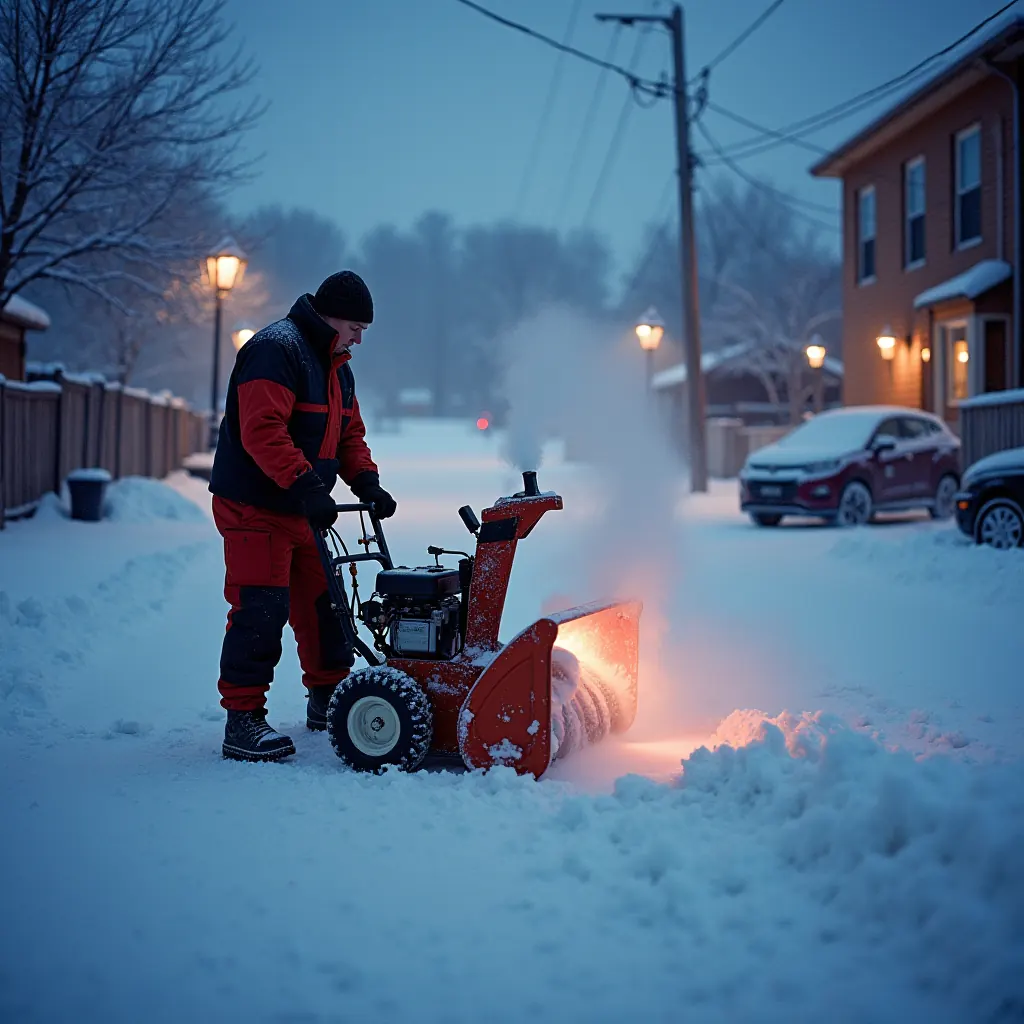
In Quebec, the median hourly wage for a snow shoveller is $21.89. For heavy equipment operators, the occupation Job Bank links to the commercial snow removal loader operator, it is $36.00. Here is what it takes to land a snow blower operator job or a loader job: training, licence class, storm duties and how you get paid, as an employee or a subcontractor.
From the shovel to the cab: what really changes
In snow removal, machinery comes in several forms: a wheel loader with a plow blade or a snow blower, a tractor with a blower, a truck with a plow and spreader, a small sidewalk machine. A shoveller clears steps, narrow driveways and the corners a machine cannot reach. An operator opens parking lots and driveways, piles or blows the snow, and often runs the whole route.
Why does the operator earn more? Because they are trusted with an expensive machine, the safety of pedestrians and vehicles nearby, and keeping the route on time while clients wait. That responsibility, more than physical strength, is what the employer pays for.
Recognized training
The recognized training in Quebec for heavy equipment is the DEP (Diploma of Vocational Studies) Conduite d'engins de chantier (heavy equipment operation, program 5220), which runs 1,095 hours. You learn the loader, bulldozer, grader and excavator, plus the backhoe loader and the roller compactor. The target trade is heavy equipment operator (except cranes), for example construction heavy equipment operator.
To be admitted, you must meet one of these conditions: hold a high school diploma or equivalent; be at least 16 on September 30 and have passed Secondary III language of instruction, second language and math; or be at least 18 and pass the functional prerequisites, including the general development test. Some centres add a selection test.
The DEP is not the only way in: an employer can also train you on its own machine. In that case, remember one rule: training required by the employer is work time, so it is paid (see Minimum wage in Quebec: what it covers and what it does not).
Your licence: class 5 or class 3?
The right class depends on the vehicle, not the job. The SAAQ defines a tool vehicle (véhicule-outil) as a road vehicle, other than one built on a truck chassis, made to perform a task, with its work station built into the driver's station; wheel loaders and graders are the usual examples. It can be driven with a class 5 licence. A heavy truck requires class 3.
| Vehicle | Licence class |
|---|---|
| Tool vehicle (wheel loader, grader) | Class 5 |
| 2-axle truck under 4,500 kg net mass (pickup with a plow) | Class 5 |
| 2-axle truck of 4,500 kg or more net mass | Class 3 |
| Truck with 3 or more axles | Class 3 |
| Heavy vehicle with air brakes | Add the F endorsement |
Snow blowers need checking. The SAAQ lists the snow blower separately (a vehicle with a mechanical device that blows snow), but many blowers are attachments mounted on a loader or a tractor. Ask the employer which vehicle you will drive and, if needed, confirm the class with the SAAQ.
For class 3, plan on at least a few months. You need 2 years of experience with a probationary or class 5 licence, fewer than 4 demerit points, no suspension for points or a Criminal Code offence in the last 2 years, a medical and vision report, and a passed knowledge test ($13.50, 75% pass mark). The learner's licence costs $88.35 and is valid for 18 months. You must hold it for at least 3 months (or 1 month if you are 25 or older, among other cases) before the two road tests.
Your responsibilities in a storm
In the cab, the day starts before the snow. If you drive a heavy vehicle, you must make sure a pre-trip inspection (ronde de sécurité) was done in the last 24 hours, or do a new one; heavy-vehicle driving and rest hours also apply. According to the SAAQ, yellow beacons may be turned on only during snow removal, when circumstances require it.
On hours, a storm does not suspend the Act respecting labour standards. The normal workweek is 40 hours; beyond that, an employee is entitled to a 50% premium. An employee may also refuse to work more than 2 hours beyond their usual hours or more than 14 hours in a 24-hour period (12 hours if their hours vary), or more than 50 hours in a week. That right does not apply when there is a danger to life, health or safety, a risk of serious damage to property, or another case of force majeure. A major storm may fall under those exceptions; for a specific case, the CNESST decides.
Finally, the fender-bender. If you damage a fence or a car, your employer cannot deduct the amount from your pay without your written consent for that specific purpose. Note the time, the address and the damage, take a photo and tell your supervisor right away.
What it pays, as an employee or a subcontractor
The Government of Canada's Job Bank publishes wages by job title. The figures below were updated on November 19, 2025 (reference period 2023-2024). Note: the loader operator in commercial snow removal is classified under heavy equipment operators (NOC 73400). The figures therefore cover the whole occupation, construction sites included, not snow removal alone.
| Region | Snow shovelling: low / median / high | Heavy equipment (NOC 73400): low / median / high |
|---|---|---|
| All of Quebec | $17.36 / $21.89 / $28.50 | $24.00 / $36.00 / $43.40 |
| Laurentides | $17.80 / $22.00 / $28.00 | $25.00 / $37.19 / $43.22 |
| Montréal | $18.00 / $22.88 / $31.50 | $23.25 / $38.16 / $43.75 |
| Capitale-Nationale | $18.00 / $22.00 / $28.00 | $24.00 / $38.56 / $43.75 |
| Montérégie | $17.00 / $21.00 / $29.00 | $25.00 / $39.55 / $43.75 |
These are benchmarks: a seasonal beginner on a loader sits closer to the low end. But the gap with the shovel shows even at the bottom of the scale, and overtime on storm nights adds up.
A subcontractor who shows up with their own machine does not earn a wage: they bill an hourly rate or a flat fee that must cover the machine, insurance, fuel, maintenance and waiting time. No official scale sets that rate; work out yours with Setting your hourly rate as a self-employed worker: the simple method. And if you operate a vehicle with a gross vehicle weight rating of 4,500 kg or more, it is a heavy vehicle under the law: the SAAQ notes that owners and operators of heavy vehicles must be registered with the Commission des transports du Québec.
Making the move this season
Fall is the right time, since companies fill out their crews before the first snow. Here is the logical order:
- Check your licence. Class 5 is enough for a loader or a grader. For a heavy truck, start class 3 now: the minimum learning period is counted in months.
- Ask for training on the machine, paid, with an experienced operator, before your first solo route.
- Learn the route in daylight: hydrants, manholes, curbs and fences are easier to spot without snow.
- Update your profile. On GPP Emploi, add your driver's licence and cards to your Passport, list your night and weekend availability, then use the "Disponible maintenant" (available now) button, which puts you at the top of employers' lists for 48 hours.
- If you own a machine, turn on "Des contrats à mon compte" (contracts on my own account) and answer quote requests with your price.
Jobs and contracts in this trade are grouped on the snow removal page. The full picture of the trade, including pay and schedules, is in Snow removal worker in Quebec: pay, hours, licences and how to get hired. No profile yet? Sign up for free, no résumé, in about 3 minutes.
In short
- The recognized training is the DEP Conduite d'engins de chantier (5220, 1,095 hours); training required by the employer must be paid.
- A loader or a grader (tool vehicle) is driven with class 5; a 2-axle truck of 4,500 kg or more, or a truck with 3 or more axles, requires class 3.
- In Quebec, the median wage for snow shovelling is $21.89 an hour, versus $36.00 for heavy equipment operators as a whole (2023-2024 data).
- In a storm: pre-trip inspection for a heavy vehicle, overtime after 40 hours, and no deduction for damage without your written consent.
- A subcontractor sets their own rate, which must cover the machine and its costs.
Frequently asked questions
What licence do I need to drive a loader for snow removal?
A wheel loader is a tool vehicle under SAAQ rules and can be driven with a class 5 licence. A 2-axle truck of 4,500 kg or more net mass, or a truck with 3 or more axles, requires class 3. Always confirm the exact vehicle with the employer.
How much does a loader operator earn in Quebec?
Job Bank classifies the commercial snow removal loader operator under heavy equipment operators, whose hourly wage in Quebec ranges from $24.00 to $43.40, with a median of $36.00 (2023-2024). These figures cover the whole occupation, construction included.
Do I need a DEP to operate a snow blower?
The DEP Conduite d'engins de chantier is the recognized training for heavy equipment, but an employer can also train you on its own machine. Ask what they require. Training they impose is work time and must be paid.
How long does it take to get a class 3 licence?
First, you need 2 years of experience with a probationary or class 5 licence. After the medical report and the knowledge test, you must hold your learner's licence for at least 3 months, or 1 month in some cases, such as being 25 or older. Then come two road tests.
Is a snow removal operator entitled to time and a half?
As a general rule, yes: an employee is entitled to a 50% premium beyond 40 hours a week. The law has a few exclusions, for example an employee who works outside the establishment and whose hours cannot be controlled. For a specific case, consult the CNESST.
Sources
- Préposé/préposée au pelletage de neige - entretien des terrains au Québec | Salaires - Guichet-Emplois
- Opérateur/opératrice de chargeuse - déneigement commercial au Québec | Salaires - Guichet-Emplois
- Conduite d'engins de chantier (DEP 5220) - Admission FP
- Classes de permis de conduire (SAAQ, C-6725)
- Permis de conduire camion (classe 3) - SAAQ
- Véhicules affectés au déneigement : catégories de véhicules et plaques d'immatriculation (SAAQ)
- N-1.1 - Loi sur les normes du travail
- P-30.3 - Loi concernant les propriétaires, les exploitants et les conducteurs de véhicules lourds, article 2