Self-employed taxes: deductible expenses and instalment payments

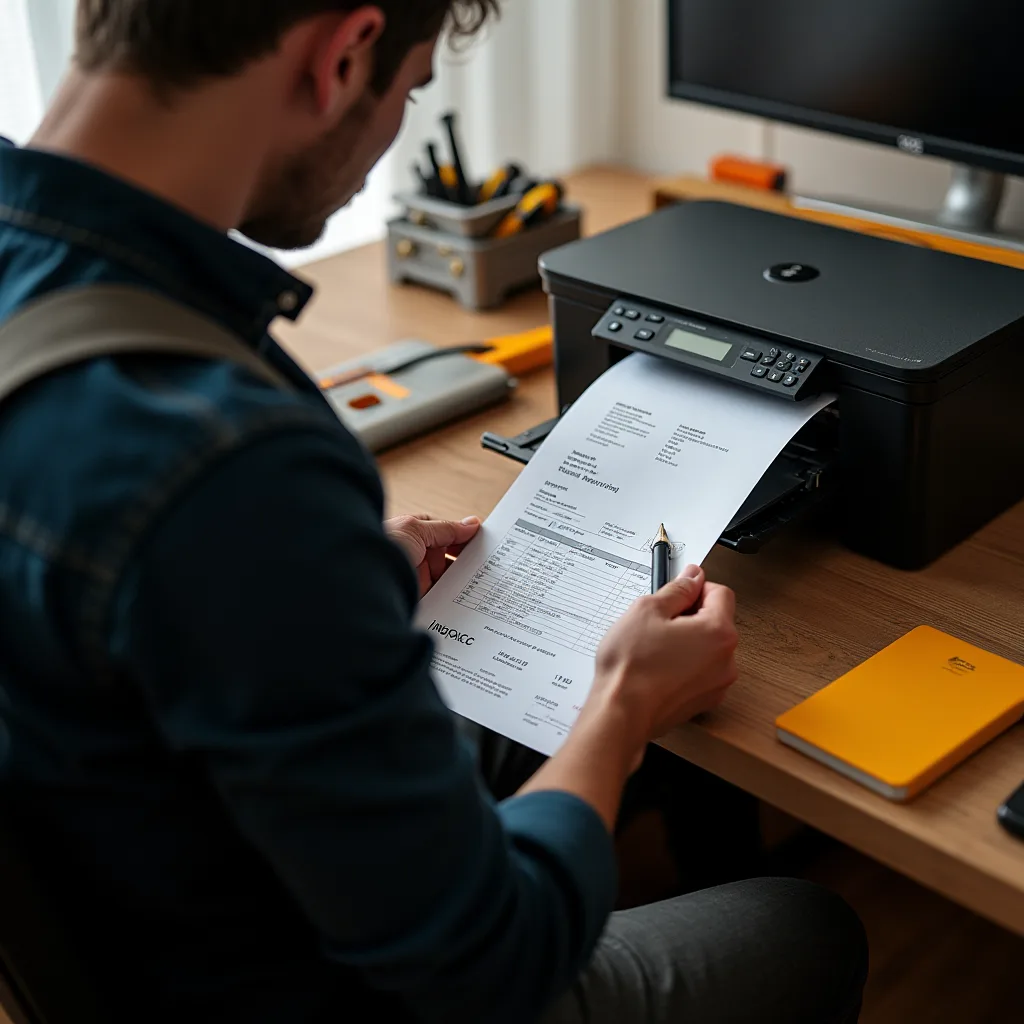
Mid-April, the kitchen table. A shoebox full of faded gas receipts, a cellphone statement, and you hunting for the invoice for the saw you bought in July. That evening is prepared in November, ten minutes a week. Here are the expenses you can deduct in a service trade, the paperwork to keep and how instalment payments work, both federally and in Québec.
The principle: a reasonable expense, made to earn your income
When you work for yourself, nobody withholds tax from your pay. In return, you report your business income minus your expenses. In Québec, you do it twice: on form T2125 for the Canada Revenue Agency (CRA) and on form TP-80 for Revenu Québec, attached to your income tax returns.
The basic rule, as Revenu Québec puts it: a reasonable expense incurred to earn business income is deductible. What isn't: the personal part of an expense, investments, costs incurred before your business started operating, and big long-lasting purchases, which aren't deducted all at once but depreciated over several years (that's capital cost allowance, or CCA).
What follows is general information, not personalized advice. For your specific situation, contact the CRA, Revenu Québec or an accountant. And if you haven't gone through the start-up obligations yet, begin with Becoming self-employed in Quebec: the steps from A to Z.
Do it today: open a bank account just for your business. It isn't a legal requirement, but it's the move that makes everything else simpler.
Common expenses in the service trades
A painter, a house cleaner and a snow removal contractor don't have the same bills, but they share roughly the same families of expenses. Here are the most frequent ones, with how they're generally treated.
| Expense | Example | How it's deducted |
|---|---|---|
| Vehicle | Gas, insurance, maintenance, registration | Based on the share of business kilometres |
| Small tools | $180 sander, brushes, shovels | Under $500 per tool: Class 12, 100% rate |
| Large tools and equipment | Snowblower, $900 compressor | $500 or more per tool: Class 8, 20% rate |
| Computer | Laptop for quotes | Class 50, 55% rate |
| Products and supplies | Paint, cleaning products, salt | Deductible when used for your contracts |
| Cellphone and internet | Monthly plan | The business-use portion |
| Insurance, business taxes, licences | Liability insurance, annual fees | Deductible |
| Meals and entertainment | Lunch with a client | Generally 50% of the amount |
The classes and rates come from the CRA. Depreciation has its own rules, including for the year of purchase, so don't eyeball the calculation. For meals, Revenu Québec applies the 50% limit plus a ceiling based on your sales; the guide Business and Professional Income (IN-155-V) gives the details.
Do it today: list last month's expenses and sort them into the rows of the table. Whatever doesn't fit anywhere is probably personal.
The vehicle: your logbook is worth money
For most self-employed people in the service trades, the truck or car is the biggest expense. The CRA accepts the business part of: registration and licence fees, fuel and oil, insurance, interest on the loan used to buy it, maintenance and repairs, leasing costs, and the vehicle's CCA.
The calculation is simple: business kilometres divided by total kilometres, multiplied by total expenses. The CRA's example: 27,000 business km out of 30,000 km in total, with $7,000 in expenses, gives a $6,300 deduction.
The catch is the proof. Your logbook must show, for each business trip:
- the date;
- the destination;
- the purpose (quote at a client's, buying materials, a contract);
- the number of kilometres.
Also write down the odometer reading at the start and end of the year. The CRA allows a lighter method: a full logbook for one base year, then a representative three-month logbook in later years, as long as the result stays within 10% of the base year. The logbook in the glove box isn't just there to keep your coffee steady.
Do it today: take a photo of your odometer and start your logbook (paper or app). Every week without one means kilometres that are hard to justify.
The home office and the cellphone
Do you write your quotes and invoices in a corner of the spare room? You may be able to deduct part of it. According to the CRA, you must meet one of these two conditions:
- it's your principal place of business;
- you use the space only for your business and use it regularly and continuously to meet clients.
For a worker who spends the day at clients' homes, the first condition can apply when you run everything from home: quotes, scheduling, invoices. You calculate the share using a reasonable method, for example the office's area divided by the home's area. That share applies to heating, electricity, home insurance, maintenance, property taxes and mortgage interest. Careful: these expenses can't create or increase a loss; the excess carries forward to the next year. Revenu Québec also has its own rules for these expenses: check guide IN-155-V before you fill in your TP-80.
The cellphone is deductible for the portion used for your business. If your phone rings mostly for clients, document it: one typical month of statements, annotated, beats a random estimate.
Do it today: measure your office and your home's living area, and keep the calculation with this year's paperwork.
The paperwork to keep, and for how long
An expense without a supporting document is an expense you risk losing if questions come up. The CRA asks you to keep your records and supporting documents for six years from the end of the last tax year they relate to. It also recommends storing both paper and electronic records securely.
The checklist:
- the invoices you issue, with taxes if you're registered;
- receipts and bills for purchases (gas, tools, products);
- bank and credit card statements;
- the logbook;
- contracts, accepted quotes and payment schedules;
- cellphone, insurance and registration bills.
A photo of the receipt at the moment you buy, filed in a folder by month, solves most April headaches. For your invoices and sales taxes, review GST and QST: when must a self-employed worker register?.
Do it today: create one folder per month (on your phone or in a paper file) and empty your receipts into it every Friday.
Instalment payments: pay in four parts instead of one
Since nobody withholds tax at source on your contracts, the governments sometimes ask you to pay during the year, in four payments. These are instalment payments, and they exist both federally and in Québec.
| CRA (federal) | Revenu Québec | |
|---|---|---|
| Who has to pay | Québec residents whose net tax owing is over $1,800 in 2026, and also in 2025 or 2024 | Individuals whose estimated net income tax payable is over $1,800 for the year, and was over $1,800 for either of the two previous years |
| Due dates | March 15, June 15, September 15, December 15 | March 15, June 15, September 15, December 15 |
| Calculation | No-calculation (reminder amount), prior-year or current-year option | No-calculation (form TPZ-1026.A-V), previous-year or current-year method (form TP-1026-V) |
| Late or too little | Interest compounded daily; penalty only if the year's interest is over $1,000 | Interest on overdue payments, plus 10% a year if you paid less than 75% of the amount owed |
In Québec, instalments cover income tax and certain Québec contributions. With the CRA, you can reduce interest by paying your next instalments early or paying more. In your first good year, you often have no instalments to make, because previous years were under the threshold: the bill lands all at once in the spring. The CRA notes that self-employed people have until June 15 to file their return, but any balance owing is due April 30.
So the payments don't catch you off guard, build them into your price: that's the logic behind Setting your hourly rate as a self-employed worker: the simple method. And before December 31, review your numbers with Year-end for the self-employed: getting your numbers ready before December 31.
Do it today: every time you get paid, set aside a fixed percentage in a separate account. Set that percentage with an accountant based on your expected income.
The bottom line
Keep your receipts, maintain your logbook and set aside the tax money with every payment. To find your next contracts without paying for ads, turn on your self-employed profile from the self-employed page: it's free.
Frequently asked questions
What expenses can a self-employed person deduct in Quebec?
Reasonable expenses incurred to earn your business income: the business part of your vehicle and cellphone, tools (depreciated according to their class), products and supplies, insurance, business taxes and licences, and part of your home office costs if you meet the conditions. Meals and entertainment are generally limited to 50%. Personal expenses are never deductible.
Who has to pay tax instalments in Quebec?
Federally, a Québec resident must pay them if their net tax owing is over $1,800 in 2026, and also in 2025 or 2024. Revenu Québec applies a similar $1,800 threshold for Québec income tax, for the current year and either of the two previous years. The reminders sent by both tax authorities show the suggested amounts.
When are tax instalments due?
Instalments are due on March 15, June 15, September 15 and December 15, for both the CRA and Revenu Québec. Farmers and fishers make a single annual payment instead. A late or insufficient payment can lead to interest charges.
How long should a self-employed person keep receipts?
The CRA generally asks you to keep records and supporting documents for six years from the end of the last tax year they relate to. Keep receipts, invoices you issued, bank statements and your logbook. Well-organized electronic copies are accepted if they're stored securely.
Can I deduct my cellphone as a self-employed worker?
Yes, for the portion used for your business. If your phone is also used for personal calls, you need to split the expense in a reasonable way. One typical month of annotated statements helps support the share you choose.
Sources
- Who has to pay - Required tax instalments for individuals
- Instalment Payments (Revenu Québec)
- Making Instalment Payments (Revenu Québec)
- Calculating Instalment Payments (Revenu Québec)
- Additional Interest on Overdue Instalment Payments (Revenu Québec)
- Operating Expenses (Revenu Québec)
- Meal and Entertainment Expenses – Operating Expenses (Revenu Québec)
- Motor vehicle expenses
- Business-use-of-home expenses
- Classes of depreciable property
- Where to keep your records, for how long and how to request the permission to destroy them early
- Self-employed? Make filing easier with these tips from the CRA
- Méthodes de calcul - Devoir payer ses impôts par acomptes provisionnels (French page)
- Frais d'intérêts et pénalités – Devoir payer ses impôts par acomptes provisionnels (French page)