Using your vehicle for work: how to deduct the costs
The 73 cents per kilometre announced for 2026 is not how a self-employed worker calculates the deduction. It is the most common mistake with vehicle costs, and it can be expensive in an audit. Here is how to deduct vehicle expenses under CRA rules: the business portion, the logbook, eligible costs, the 2026 limits and two complete examples.
The basic rule: only the business portion is deductible
The tax principle is simple: you can deduct expenses incurred to earn business income, but not your personal expenses. Since most self-employed workers use the same vehicle for clients and for groceries, the Canada Revenue Agency (CRA) asks you to split the costs by kilometres. The formula is:
(business kilometres ÷ total kilometres) × total vehicle expenses
The CRA's example: a truck driven 27,000 km for business out of 30,000 km in total, with $7,000 in expenses, gives a deduction of $6,300. That percentage is the heart of your claim. It must be accurate and documented, because it is the first thing checked in an audit.
What counts as a business trip? Going to a client, to a job site, to a supplier to buy materials, to the bank for the business, or from one client to another. Personal outings don't count, even with your tools in the truck bed. Whether the trip from home to your first client counts depends on where you run your business from: more on that below.
The mileage logbook: your only real proof
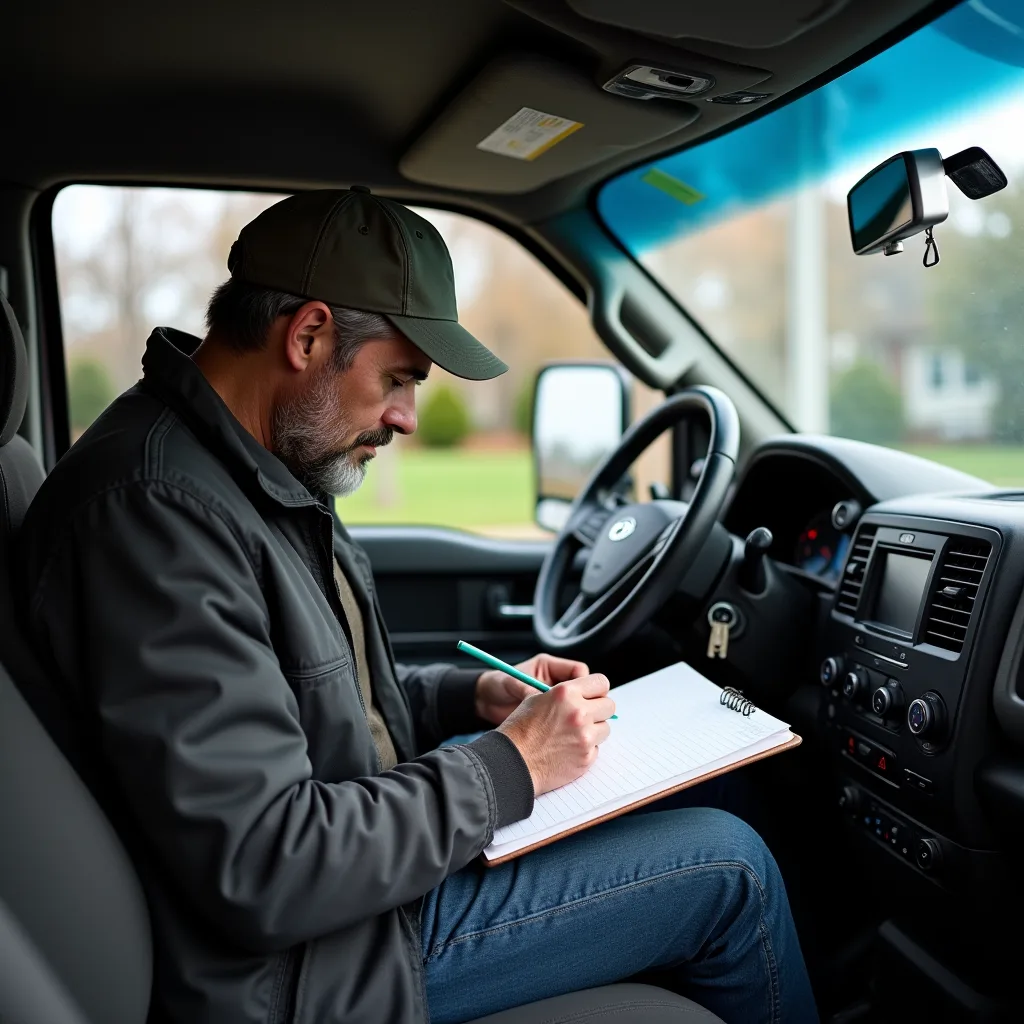
According to the CRA, the best evidence is a logbook kept for the whole year. For each business trip, you record the date, the destination, the purpose and the kilometres driven. You also note the odometer reading at the start and end of the fiscal period, and when you buy, sell or trade in a vehicle. If you have two vehicles, each gets its own logbook.
| Date | Destination | Purpose | Km |
|---|---|---|---|
| December 3 | Rue des Érables, Saint-Jérôme | Snow removal, seasonal contract | 14 |
| December 3 | Hardware store, Mirabel | Buying salt and parts | 22 |
| December 4 | Chemin du Lac, Sainte-Adèle | Quote at a client's home | 31 |
Keeping a full logbook every year is tedious. The CRA therefore accepts a simplified logbook: you keep a full logbook for a representative 12-month base year, then, in later years, a logbook for at least three consecutive months. Business use for the year is then calculated as: (sample period percentage ÷ percentage for the same months in the base year) × base year annual percentage.
There are two safeguards. The sample period percentage must stay within 10 points of the same months in the base year, and the calculated annual result must also stay within 10 points of the base year. Otherwise, the base year is no longer reliable and you need full records. Keep the base-year logbook for six years after the end of the last year you use it. For a snow removal operator, whose use varies enormously between winter and summer, this point is critical: a January sample is compared with January of the base year, not with the yearly average.
Eligible expenses
The CRA lists the vehicle operating costs you can claim, always in proportion to business use:
- licence and registration fees;
- fuel and oil (or electricity for a zero-emission vehicle);
- insurance;
- interest on money borrowed to buy the vehicle;
- maintenance and repairs;
- leasing costs.
Two expenses are exceptions and are deductible in full: business-related parking fees and supplementary business insurance. On top of that comes capital cost allowance (CCA), which spreads the purchase cost of the vehicle over several years and is calculated separately. Federally, vehicle expenses go on line 9281 of Form T2125 and CCA on line 9936.
Keep all your receipts: the CRA requires reasonable expenses supported by vouchers. For the full picture of your expenses and instalment payments, see Self-employed taxes: deductible expenses and instalment payments.
Pickup, van or car: the category changes everything
The CRA distinguishes a motor vehicle from a passenger vehicle. The distinction matters because only passenger vehicles are subject to limits on CCA, interest and leasing. A passenger vehicle is designed mainly to carry people and seats a driver and no more than eight passengers; most cars, vans and some pickups fall into this category.
Work vehicles can, however, escape that category:
- a pickup or van with 1 to 3 seats used to haul goods or equipment is a motor vehicle if its business use is more than 50%;
- an extended-cab pickup, a sport utility or a van with 4 to 9 seats is a motor vehicle if it is used 90% or more to transport goods, equipment or passengers to earn income.
| 2026 limit (passenger vehicles) | Amount |
|---|---|
| Maximum cost for CCA, vehicle acquired on or after January 1, 2026 | $39,000 before tax |
| Maximum cost for CCA, zero-emission vehicle | $61,000 before tax |
| Deductible interest on a new loan | $350 a month |
| Deductible leasing costs, new lease | $1,100 a month before tax |
These limits were announced by the Department of Finance Canada on January 14, 2026, and Revenu Québec applies the same amounts for 2026.
Two examples: a snowplow truck and a van
The amounts below are examples to illustrate the method; use your own receipts and your own logbook.
1. The self-employed snow removal operator and a regular-cab pickup
A 3-seat pickup equipped for snow removal that also carries equipment. Logbook: 14,000 business km out of 20,000 km, or 70%. Since business use exceeds 50%, it is a motor vehicle: no cost or interest limit. Expenses for the year: fuel $5,400, insurance $2,100, maintenance and repairs $1,900, registration $350, interest $1,250, for a total of $11,000. Deduction: $11,000 × 70% = $7,700, plus CCA calculated at 70% and business parking in full.
2. Home cleaning and a 7-seat van
A 7-seat family van that carries the vacuum and supplies to clients' homes. Logbook: 12,000 business km out of 24,000 km, or 50%. It doesn't reach 90% work use: it is a passenger vehicle, subject to the limits. Expenses: fuel $3,600, insurance $1,800, maintenance $1,200, registration $300, interest $2,400 ($200 a month, under the $350 limit), for a total of $9,300. Deduction: $9,300 × 50% = $4,650, plus CCA, calculated on a maximum cost of $39,000 if the vehicle was acquired in 2026.
The lesson: the category and the percentage weigh more than any receipt. A 3-seat pickup used 45% for business becomes a passenger vehicle again. Review your logbook before year-end, as suggested in Year-end for the self-employed: getting your numbers ready before December 31.
The home-to-client trip and the famous 73 cents per kilometre
The trip from home. An older CRA interpretation bulletin (IT-521R, now archived) explains the logic: trips between home and a place of business are generally personal, unless your home is the base of the business's operations. It gives the example of a plumber or electrician who does their administration in a home office and serves customers wherever their contracts take them. On the other hand, if you have a shop or premises elsewhere, the trip from home to those premises is normally personal. Since the bulletin is archived, confirm your situation with the CRA or Revenu Québec, or with a tax professional.
The per-kilometre rate. For 2026, the rate is 73 cents per kilometre for the first 5,000 kilometres and 67 cents after that (77 and 71 cents in the territories), and Revenu Québec applies the same amounts. Be careful: this rate sets the reasonable tax-exempt allowance an employer pays to employees who use their own vehicle. A self-employed worker deducts actual expenses using the business-use formula instead. Multiplying your kilometres by 73 cents is not the method for your business income.
If you are an employee and your employer has you travel between clients, different rules apply, including whether that time is paid: see Travel time between clients: is it paid?.
In short
- You deduct the business portion of your costs: (business km ÷ total km) × vehicle expenses.
- The logbook (date, destination, purpose, km) is your proof; after a full base year, three consecutive months can be enough if the gap stays within 10 points.
- Business parking and supplementary business insurance are deductible in full; CCA is calculated separately.
- A 1-to-3-seat pickup used more than 50% for work escapes the 2026 limits ($39,000, $350 a month in interest, $1,100 a month in leasing).
- The 73 cents per kilometre is for employer allowances, not for the self-employed deduction.
Want more contracts to fill that logbook? Turn on "Des contrats à mon compte" and answer requests for quotes. Everything is explained on the self-employed page, and the guide Becoming self-employed in Quebec: the steps from A to Z covers the first steps.
Frequently asked questions
How do I calculate the deduction for using my vehicle?
Divide your business kilometres by your total kilometres for the year, then multiply that percentage by your total vehicle expenses. Business parking and supplementary business insurance are deductible in full. Capital cost allowance is calculated separately.
Can a self-employed person use the 73 cents per kilometre rate?
That rate sets the reasonable tax-exempt allowance an employer pays its employees. A self-employed worker deducts actual expenses instead, in proportion to business use. If in doubt, check with the CRA or Revenu Québec.
Do I have to keep a mileage logbook?
The CRA says a logbook is the best evidence of business use. Without one, it is hard to support your percentage in an audit. After a full base year, a logbook for three consecutive months can be enough under certain conditions.
Is the trip from home to my first client deductible?
It depends on where you run your business from. If your home is the base of your operations, trips to clients are generally treated as business travel; if you have premises elsewhere, the trip from home to those premises is normally personal. Confirm your case with the CRA, Revenu Québec or a professional.
What is the vehicle cost limit for 2026?
For a passenger vehicle acquired on or after January 1, 2026, CCA is calculated on a maximum cost of $39,000 before tax, and $61,000 for an eligible zero-emission vehicle. A 1-to-3-seat pickup used more than 50% to haul equipment is not subject to this limit.
Sources
- Motor vehicle expenses - Canada Revenue Agency
- Documenting the use of a vehicle - Canada Revenue Agency
- Government Announces the 2026 Automobile Deduction Limits and Expense Benefit Rates for Businesses
- Limits and Rates Related to the Use of an Automobile for 2026 - Revenu Québec
- ARCHIVED - Motor Vehicle Expenses Claimed by Self-Employed Individuals (IT-521R)