Snow removal: the race for crews before the first snowfall
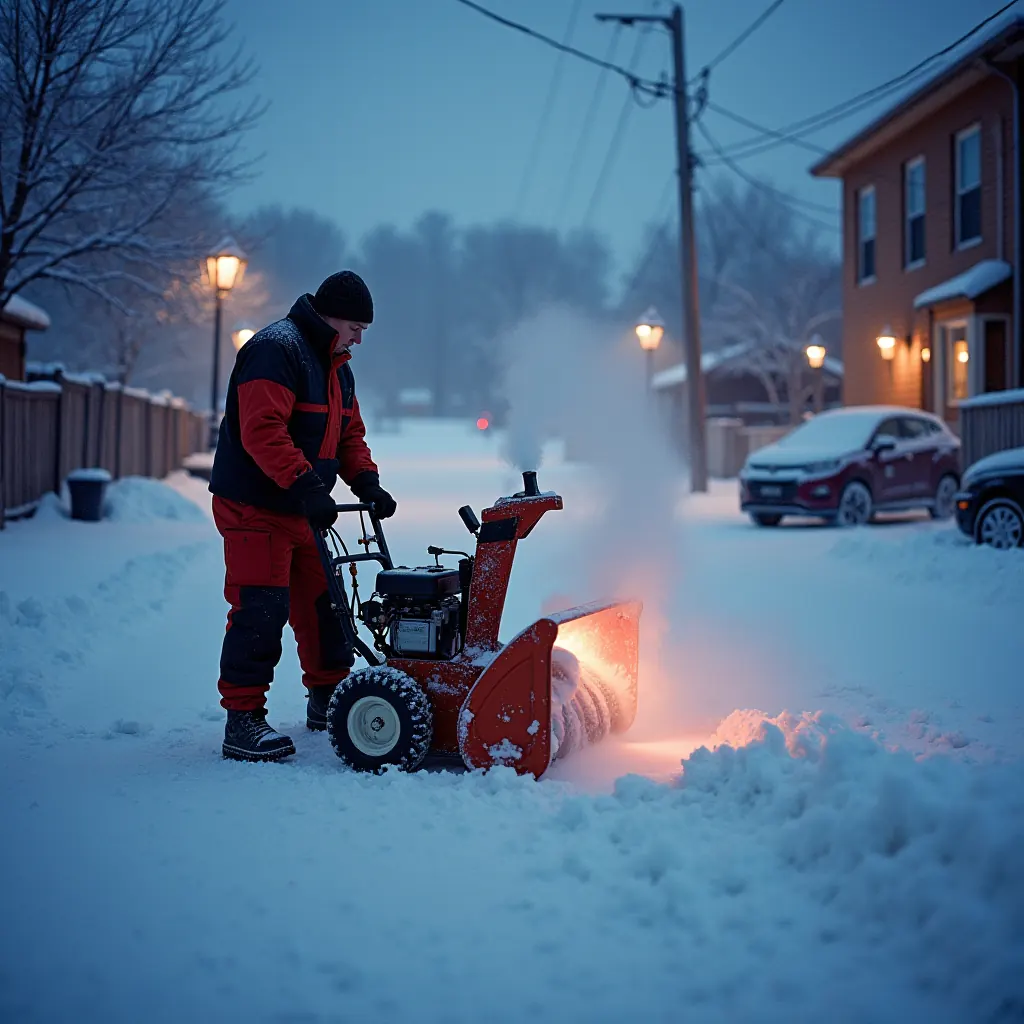
Why does a snow removal company that starts recruiting after the first snowfall almost always finish the season short-handed? Because the rest of the calendar is set before then: seasonal contracts are signed in the fall, several municipal permits start on October 1 or November 1, and winter tires are mandatory from December 1. Here is the typical hiring calendar, the rules that frame storm work and how to read the requests displayed live.
Why the race is decided before the first snowfall
Snow removal is a service sold in advance. Homeowners, property managers and businesses sign a seasonal contract in the fall, with a list of addresses and often a deadline (a driveway cleared before 7 a.m., a parking lot ready before opening). Once the contract is signed, the company is committed to deliver after every storm, whether it has two operators or six.
The result: the demand for workers arrives all at once. Every company in a region looks, at the same time, for snowblower and loader operators, drivers, shovellers and a mechanic. Many of these workers come from landscaping, whose season ends in the fall; those with a confirmed winter job in October are no longer available in December.
For workers, the logic runs the other way. Being visible in October means choosing your routes, your hours and your employer. After the first real storm, what is left is mostly replacements. You will find the same pattern, trade by trade, in Winter jobs in Quebec: the trades hiring from November to March.
The typical hiring calendar, month by month
No law sets the start of the season, but a few official dates shape the calendar. The table combines these milestones (last column) with how a typical season unfolds.
| Period | Company side | Worker side | Official milestone |
|---|---|---|---|
| September to mid-October | Sign contracts, count routes, estimate the number of operators | Update your profile and cards | — |
| October 1 | Apply for vehicle permits in Montréal boroughs whose permit period starts on that date | — | Private snow removal contractor permit (Montréal, depending on the borough) |
| Mid-October to late November | Post job offers, invite profiles, hold interviews | Apply, answer invitations | — |
| November 1 | Permit period starts in other boroughs | — | Same permit |
| November | Train, drive the routes in daylight, test equipment | Learn the addresses, try the machine | — |
| December 1 | Crew pickups and cars on winter tires | Your own vehicle too | Winter tires mandatory until March 15 (heavy vehicles exempt) |
| December to March | Replace departures, add roof shovellers after big storms | Make yourself available for replacements | — |
Key takeaway: most hiring happens between mid-October and late November. On GPP Emploi, a job offer stays online for 45 days; posted around October 15, it covers that window almost exactly. After the first storm, the best candidates have already said yes elsewhere.
What live requests show, and how to read them
Why look at customer requests to predict hiring? Because a company that signs more contracts than last year will need more hands a few weeks later. The snow removal requests that companies take on GPP Central are therefore a leading indicator for job offers. GPP Emploi displays them live, by trade and by region, in the section called “Ce que personne d'autre ne voit” on the home page. The figures change every day: the home page remains the up-to-date source.
Three ways to use this data:
- Compare your region with its neighbours. If demand is rising in the next region, companies there will recruit further away. The regional pages show the offers open elsewhere.
- Follow the trend, not the day. A rise that lasts a week in October signals job offers in November; a single day does not say much.
- For employers: turn on the Central signal. When your company takes more requests than usual on GPP Central, GPP Emploi immediately shows you the available workers near you. You see the need coming before you fall behind.
The snow removal page groups the job offers and requests for quotes open in this trade: that is where you see whether the season has started near you.
The rules that frame a season of storms
Snow removal is one of the few trades where the schedule depends on the weather. The CNESST does not set a special standard work week for this trade: for an employee, the general labour standards apply.
| Rule | What the rule says | Example |
|---|---|---|
| Minimum wage | $16.60 an hour since May 1, 2026 | The floor for any employee job offer |
| Standard work week | 40 hours; beyond that, time and a half | At minimum wage, an overtime hour is worth $24.90 |
| 3-hour indemnity | 3 hours paid if you report for work and work less than 3 hours, or if you are called in exceptionally for less than 3 hours | Called in for a 1.5-hour run: paid 3 hours |
| Refusing overtime | Allowed beyond 2 hours more than your usual daily hours or 14 hours in 24 hours; 12 hours in 24 hours if your hours are variable or non-continuous; beyond 50 hours a week | Variable night schedule: refusal possible after 12 hours |
| Weekly rest | 32 consecutive hours | Plan it between two storms |
A sample calculation, using a hypothetical rate of $22 an hour and a 52-hour storm week: 40 hours at $22 come to $880, and 12 overtime hours at $33 come to $396, for a gross total of $1,276. A candidate wants to see this calculation clearly in the job offer.
The exceptions matter as much as the rule. The right to refuse does not apply if refusing would endanger the life, health or safety of other people, risk the destruction of or serious damage to property, or in a case of force majeure. A storm does not trigger these automatically: it depends on the situation. The 3-hour indemnity also has exceptions, including force majeure (a prolonged power outage, for example). These rules cover employees, not the self-employed worker who sells a result. For a specific case, the CNESST decides.
Licences, cards and safety: what to check before the first run
The right driver's licence
According to the Société de l'assurance automobile du Québec (SAAQ), Class 5 covers cars, two-axle trucks with a net mass under 4,500 kg, and tool vehicles. Class 3 is required for a straight truck with three or more axles, or with two axles and a net mass of 4,500 kg or more. A dump truck with a plow therefore often falls under Class 3. For a loader on public roads, ask the employer how it is registered.
The company's municipal permit
In Montréal, a private snow removal contractor must get a permit for each vehicle used, and the rules vary by borough. Depending on the area, the permit is valid from October 1 to May 1, from November 1 to April 15 or April 30, or from June 1 to May 31. You usually need your registration with the Registraire des entreprises (REQ), proof of liability insurance, each vehicle's registration and the list of addresses. Base fees range from $32.50 to $118.10 depending on the borough, plus an amount per additional vehicle. Other cities have their own rules: check with your municipality.
Roof snow removal
The CNESST requires that workers exposed to a fall of more than 3 metres be protected: guardrails or an equivalent means first, and a harness attached to an anchor point if that is not possible. It also recommends marking a 2-metre buffer zone with a warning line along the roof edge and working from the ground with a telescopic roof rake whenever possible.
For employers, the useful move is to write these requirements into the job offer (licence class, type of machine, work at heights). A candidate who knows what to expect does not back out on day one.
How to win the race on GPP Emploi
For employers, posting is free. Choose an “Offre d'emploi” (job offer) if you control an employee's schedule and work, or a request for quotes if you are hiring a self-employed worker with their own equipment to deliver a result at their own price. In the profile bank, filter by region, trade and “dispo maintenant” (available now), then invite (an invitation is valid for 7 days). You pay only when a contact is accepted: generally 2 credits ($50), refunded if the person you hired does not show up on day one and confirms it. The method for building the offer is in Hiring for winter: recruiting snow removal crews before the first storm.
For workers, everything is free. The profile takes about 3 minutes, with no résumé. Add your driver's licence and cards to your Passport, list your night and weekend availability, and set your alerts: you get a text message for matches of 85% and up, never at night. After a big storm, the “Disponible maintenant” (available now) button puts you at the top of employers' lists for 48 hours. Your name and cell number stay hidden until you accept an employer.
In short
- Snow removal hiring mostly happens between mid-October and late November, before the first real storm.
- The requests displayed live on the GPP Emploi home page signal hiring needs a few weeks ahead.
- For employees: $16.60 an hour minimum, time and a half after 40 hours, a 3-hour indemnity and a regulated right to refuse overtime.
- Before the first run: the right licence class, a per-vehicle municipal permit in Montréal, winter tires by December 1 and fall protection on roofs.
Frequently asked questions
When should I start looking for a snow removal job?
Ideally in October. Fall is when companies sign their seasonal contracts and build their crews. After the first storm, the remaining openings are mostly replacements.
Do snow removal workers get time and a half?
Yes, if they are employees. Hours worked beyond 40 a week are paid at time and a half, except for the exceptions set out in the law. A self-employed worker sets their own price and is not covered by this rule.
What driver's licence do I need to drive a snowplow truck?
It depends on the truck. Class 5 covers two-axle trucks with a net mass under 4,500 kg; above that, or with three axles or more, the SAAQ requires Class 3. Check the net mass shown on the registration certificate.
Can I refuse overtime during a snowstorm?
An employee can refuse beyond certain limits, for example more than 14 hours in 24 hours, or 12 hours if their hours are variable. This right does not apply if refusing would endanger other people, risk serious damage to property, or in a case of force majeure. If you disagree with your employer, the CNESST can decide.
Do I need a permit to do residential snow removal in Montréal?
Yes, a private snow removal contractor must get a permit for each vehicle used. Validity dates, documents and fees vary by borough. Elsewhere in Quebec, check your municipality's rules.
Sources
- Standard work week (CNESST)
- Right to refuse to work overtime (CNESST)
- Time worked, breaks and 3-hour indemnity (CNESST)
- Déneiger un toit (CNESST, in French)
- Driver's licence classes (SAAQ)
- Requirements for winter tires (Québec.ca)
- Permit application for private snow removal contractors (Ville de Montréal)
- Hausse du salaire minimum - Dès aujourd'hui, le taux général du salaire minimum s'établit à 16,60 $ l'heure (in French)